I
When nostalgia was invented, it was something that happened to us.
In the late 17th century Johannes Hofer created the term in order to describe an intense melancholia that gripped soldiers who yearned to be home rather than engaging in warfare. People were gripped by nostalgia, driven into ambient madness by it, made victim by a wholly new regime of feeling that could only be labeled by creating a term that bridged pain and home. In its origin, to be nostalgic is to be gripped by something you cannot let go.
Nostalgia is different now. It’s Norman Rockwell and AI-generated images of the idyllic past. It’s drinking from the hose and thinking about Super Mario Bros or Chrono Trigger. The word gets used any time we could be posting the ending of Stand By Me: “I never had any friends later on like I did when I was twelve. Jesus, does anyone?” Nostalgia is the thing that names the feeling of what you no longer have, and the current understanding of the word is that it is ok to strive to fulfill that nostalgia — it is not painful to experience, like a live wire; it is a high that is pleasurable to ride.
II
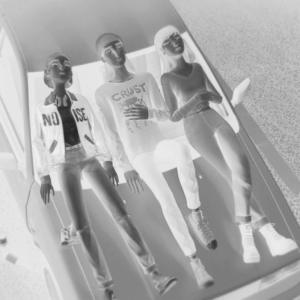
We can dress it up however we like, but the truth is that Mixtape is a vibes-driven experience riding high on some kind of media nostalgia. It is an on-rails narrative experience where you do some light exploration of a sleepy little woodland town among a group of three friends who are sitting on three different versions of the razor’s edge of adulthood, and the thing that pulls you through that narrative is a series of songs arranged into a mixtape that sets the mood for each scene in sequence. It has more in common with a set of narrative music videos like Dirty Computer than it does most other games that it sits on digital platforms with. I am sure there are people I am uninterested in engaging with who are mad about this.
The vibes-driven nature of Mixtape, a game so music-driven that the name tells you what it is, means that there are some formal elements that you have to deal with up top. The list of songs that make up the game are frankly bizarre. They are ostensibly collated and organized by the protagonist Stacy Rockford, who yearns to be a music supervisor and set the tone for other visual media for people to look at in the future. Kaile Hultner, in a “hater’s review” of the game, has already patiently walked through the strangeness of those selections and how far they are from the notional historical context of the game. The lack of anything that looks like the most popular music of the 1990s is weird, and it’s maybe less weird than the domination of “music for dads who have a garage to listen to in that garage” that takes up the vast majority of the soundtrack.
Much like the music, the fashion is a combination of 30 years of style, incoherent-to-timeless, evocative of a spirit of an era rather than anything specific. It’s like someone telling you how it was “back in the day” or gesturing to an “Victorian attitude” — it is convenient cultural shorthand for us to collapse all of time and space into an aesthetic package so that we can name it, corral it, and put it on the open market.
That’s what we call genre under capitalism. That’s the thing we’re buying and selling these days.
III
I don’t have any love in my heart for Mixtape, and the first 30 minutes of the game really befuddled me. I found it eyerollingly cliche, not in feeling but in pre-packaged teen narrative beats. I’ve written about games for a long time, and I’ve had all the emotions one can have about a game, and I have mostly evened out. Most games I do not like these days raise nothing in me at all, and they wash over me like static. I uninstall them. I go outside. I tend my garlic. I’m old now.
I do have a professional interest in Mixtape, though, and I kept at it because I wanted to know how it dealt with stringing together its music with its shortform gameplay. I am starting work on a big project about how games depict the world, and I had an understanding that Mixtape was doing interesting things there.
[As an aside, it is doing interesting things there. The most interesting parts of the game to me by far are the moments where I posed in a photo booth, kissed with tongue, skipped rocks, hit softballs, and so on. I have more to say, probably in longform published work, about those segments of the game at some point. Huge shoutout to the designers that made those.]
The reason that I experienced confusion and cliche around the game was not about the music, which seems to have set the only mode of engagement for a lot of people, but instead the visual language and genre references. Wes Anderson’s work sets the baseline standard of how Mixtape operates; John Hughes informs a vast majority of the story beats and dialogue. It’s a post-teen project, sitting in that vast realm of responses that recharacterize the teen film for a new era, a mainstay of all media since the teen was invented.
The official website reads: “On their last night of high school, three friends embark on one more adventure together. Play through a mixtape of memories, set to the soundtrack of a generation. Skate. Party. Avoid the law. Make out. Sneak out. Hang out.”
It’s all stereotypes, all genre standards, there’s nothing new under the sun. That, to be clear, is what we’re buying — a greatest hits experience. The game’s director said as much in an interview with Vice, claiming that not only is the game’s music a mixtape but so is everything else: the game mechanics, the characters, and time itself. The world is there to be rearranged into a particular shape that generates a feeling, and it’s all at your fingertips for convenient vibe-generation.
As he said in the same interview: “Mixtape isn’t saying this is a better time or these were better moments. It’s saying that these things are always the same. Like these feelings of feeling left out. And I think more importantly, kids grabbing on to art to define who they are when they don’t have life experience.”
It’s saying that things are always the same.
IV
Nothing new under the sun, of course, because what the game’s director is expressing and what the game is doing even without the voice of the creator there to verify it is something that is so bone-deep within capitalism at this point that it was diagnosed in its fullness more than thirty years ago. Writing about a Philip K. Dick story in which the 1950s return with a nostalgic full vengeance, Fredric Jameson indexed the function of nostalgia in the 1980s (he could easily have said this about Back To The Future, if you’d like a slightly more blockbuster reference):
There is, however, an even more radical possibility; namely, that period concepts finally correspond to no realities whatsoever, and that whether they are formulated in terms of generational logic, or by the names of reigning monarchs, or according to some other category or typological and classificatory system, the collective reality of the multitudinous lives encompassed by such terms is nonthinkable (or nontotalizable, to use a current expression) and can never be described, characterized, labeled, or conceptualized.
Late capitalism collapses previous eras into easy narratives and aesthetic packages. That’s what it does on a fundamental level, and the 1980s lookback at the 1950s is a symptom of a much more grand project where real history is supplanted by a commodity that is the past. The idea that the throwback project can be bought and sold as something coherent emerges out of our complete cultural disconnect with the recent past — everything real melts into genre constraint, cliche, and concept to be repackaged.
The cluster of things we imagine to be the past cannot latch onto anything real since the fullness of the past cannot be grasped, and our attachment to it is fundamentally severed by the mechanisms of capital.
For Jameson, there’s a solution in some ways because we can always historicize, but I struggle to see that potential in Mixtape. In the essay I’m quoting above, he suggests that the colonization of all aesthetics by capitalism at least provides a place where we see struggle appear in the terms of the allegorical encounter — the forces in the game might smash into each other and produce a novel outcome that we can read as attaching itself to the underlying material of the text. History might show itself.
If Mixtape isn’t really about any historical period, and it’s a mixtape of feelings and films and teen expressions from the 1970s through the end of the millennium, then the actual question I have is not whether or not it is accurate (because that’s not the point) but instead what does it produce.
V
One of the clearest things it produces is a whitewashed world where music is jangling guitar stuff and a weird reference to a Montel Jordan song that never appears. I don’t have anything more to say about that other than how truly, unthinkably bizarre it is, and that maybe literally anyone up and down the line should have thought about either the fact of that or at least an explanation as to why. It’s a lingering question that is not a gotcha but instead an inquiry into what the whole point of this endeavor is.
VI
Another thing that Mixtape clearly produces is an analogical relationship to how capital works these days. I am a simple man. I look for the relationship between an object and the world around it, and I ask “what is this like in the world?” and “what is this not like in the world?”
Mixtape is more like a Pinterest board than a mixtape. It is more like Space Jam: A New Legacy than it is Rushmore, no matter how know-it-all-and-flawed the main characters are. What I mean by these two things is that the game works off a particular kind of database logic. It sees all of recent history as a thing to sample from in the same way that you would create a vision board on Pinterest or the way you would populate a fictional crowd for LeBron. There are a series of accessible, clear cultural touchstones that can be brought together in a novel formation that will produce a feeling, and if you squint you cannot see the intellectual property seams between them.
Mixtape isn’t unique here, and I think it is instructive in being a game that is most clearly located in a vague millennial nostalgia genre that has mirage-like edges. The purpose of genre in our current moment is to put some graspable handles on aesthetics that are by their nature very blurry — whatever Mixtape is doing with its genre is no less strange and decoupled from historical conditions than terms like “weird fiction” or “dark academia” are in the circles that they operate in.
What is maybe more notable about Mixtape, and what might bring people to clear defensiveness or derision when they encounter it, is that the kind of sampling it does with the database of culture is about your emotions. Bugs Bunny shows up in Space Jam because he is intellectual property that will draw Looney Tunes fans closer to the product, and he exists in contextless space and time to be summoned whenever we need Gen X to wear a t-shirt they love. A Smashing Pumpkins song shows up in Mixtape because it is also intellectual property with emotions pre-sorted and emotionally tied to it, so that when the protagonists do teen feelings set to the song you know exactly how you’re supposed to feel. Mixtape is hardwired up to do melodrama at a level unseen by human eyes and ears, and it’s because it is elbow-deep in the songbook of the end of history. Its greatest hope is for you to know how to feel and when to feel cued by needle drops and followed up with Rockford’s contextualizing statements that hear, to my ear, like the hollow AI summaries that appear at the top of the page when I google specific Neil Young songs.
I’d feel insulted if it weren’t so sincere.
VII
My frustration, maybe, is that I’ve seen it done in more interesting ways, and I thought Mixtape might go there. It plays in irony as much as it does sincerity, and those are the best parts of the game. Stumbling drunk through the movie rental spot is good, playing off something real feeling but also blown out of proportion into heroic contexts. The magical parts of the game work just as well — running, flying, sitting in a beautiful car conducting fireworks — these are well executed and notable. While there are games that I think are doing the “teen feelings and how it impacts the self” better than this one, there’s not another game precisely like this, and certainly not one with the kind of money behind it.
What feeling is here to return to when the vague feeling of music lifted from all context, and winnowed down to flatter me, is available by creating an algorithmic Spotify playlist? I had this thought about halfway through the game, since it repeatedly kept hitting me with the smooth guitar music that one of our most evil platforms somehow keeps autoplaying for me when my playlists of metal and post-punk end. No one’s history attempting to drag us all into a given median, a space for no one, new coffee shop in the mixed use development-core.
VIII
My frustration really is not with Mixtape, but instead it is with the Jamesonian allegorical encounter that the game sets up. The biggest conceptual narrative beat is that the characters fight the cops and realize the cops are cool Leonard Cohen dads with rich inner lives who just care about us, and moreover those dads will recognize our autonomy and leave us alone for good.
This is not a conclusion I find interesting, and it’s a little too close to John Hughes without the pathos.
The other, less allegorical, encounter it sets up is between myself and the database, but guess what? I don’t need the game to do that, since every day of my waking life is staging that encounter. The game is the tail wagged by the dog of contemporary capital. There’s no thrill in an aesthetic of decontextualization and pure vibes. This is all of social media, all of work, all of labor, and it is punctuated regularly by the truth of material relations, which the dreamy Mixtape can’t be bothered to speak to whatsoever. I don’t blame anyone. It’s not their job. But the game is not providing new and rare flavors.
IX
Two unrelated thoughts to end on:
The first is that the Joseph Kahn film Detention runs into many of these same issues and prospects, and I find it (although not its director) much more compelling than this game. I think that is because it has the willingness, and seeming obligation, to be mean and upsetting about the collapse of everything into a database to be sampled. That process does feel mean to me, and I wonder if the vibe that I personally demand from it is mean in return.
The second is a return to nostalgia, the pain of our desire for the past not being given to us, and how analgesic the game ends up being. It is numbing, I think, and in that way it does provide that final Stand By Me line. He asks if anyone ever has friends like they do when they were twelve. If we cannot wholeheartedly answer yes, that we do have deep friendships with others as adults, then something has been done to us. Nostalgia was a name for something being done to us, and perhaps Grafton Tanner’s retrobait might be the word to explain what in Mixtape is being done to us. Mixtape‘s collapse of history into comforting vibes should make us question why that comfort works so easily, and more importantly, why the assumption exists that it would.